

The 60-Minute
Spray Window Plan
How to stage water, batteries, and routes so your team moves fast when the window is open — and doesn't leave acres on the table.
1 The Staging Mindset: Think Like a Pit Crew

Formula 1 teams don't figure out the tire change process during the race. Everything is choreographed, positioned, and rehearsed. Your drone spray operation needs the same thinking — not because it's complicated, but because complexity at the wrong moment kills throughput.
The core principle is simple: all refill and swap decisions should be made the night before, and all gear should be within arm's reach before the first flight. That means your water source, your battery bank, and your field routes are fully configured before you walk out to the drone.
A well-staged team running a DJI Agras T50 can realistically cover 60–80 acres in a 90-minute morning window. A poorly staged team running the exact same hardware might cover 25. The drone isn't the bottleneck — the setup is.
2 The 60-Minute Staging Timeline
Here's how a two-person crew should structure their time from the moment they arrive at the field to wheels-up on the first mission. Adjust timing to your own setup, but the sequence matters.
⚡ Pro Tip: The 3-Minute Rule
If your ground-to-air turnaround — from landing to next takeoff — takes more than 3 minutes, something in your staging is broken. Time it. Identify what's slow. Fix it before the next morning window.
Common culprits: hose coupling that requires tools, battery stored in a bag instead of a rack, app timing out between flights requiring restart, or one person trying to do both the refill and the swap alone.
3 Water Workflow: Tote, Tank, or Trailer?
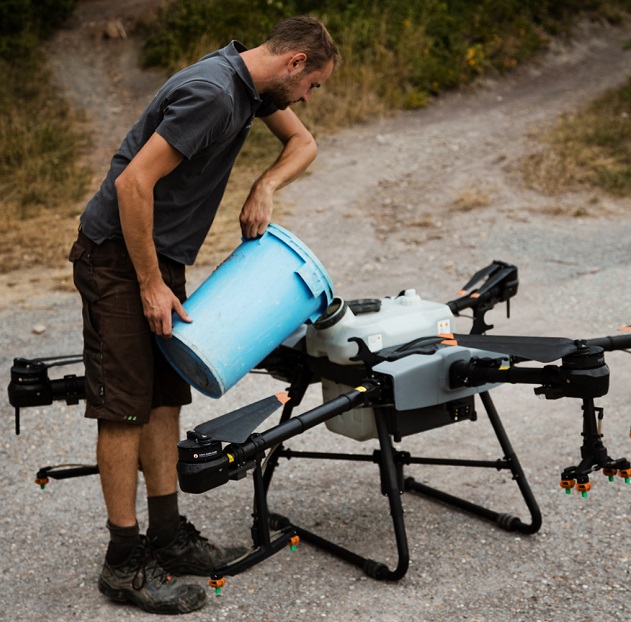
Water is the one consumable you physically cannot run out of mid-operation, and yet it's the most common reason teams stop spraying during a good window. Here's a breakdown of the three most common water setups and how to use each effectively.
Sits on a flatbed or skid. Gravity-fed or pump-assisted. Cheap to source, easy to fill the night before. The standard solution for most Prairie operators running a single T50 or T25.
Watch for: slow fill rate from gravity alone — add a 12V pump to cut fill time from 90 seconds to under 45.
1,500–3,000L tanks on a dedicated trailer give you all-day capacity without trips back to the yard. Best for high-volume commercial operators covering 200+ acres per day.
Watch for: weight and road access on soft spring fields — know your trailer's ground clearance before driving in.
Using a farm's existing sprayer tender or water wagon is cost-effective but requires coordination. Make sure the tender is pre-positioned and the fitting is compatible with your pump hose before you arrive.
Watch for: mixing residue in existing tanks — always flush if the tender previously carried a different product.
Regardless of which option you choose, the golden rule is: your water source must be at the field and ready before the window opens. Driving back to the yard to fill a tote costs you 20–30 minutes of prime spray time — and in July, that's often the whole window.
4 Battery Rotation That Never Breaks the Cycle

Battery management is where most new operators leave the most time on the table. The DJI Agras T50's batteries take roughly 25–30 minutes to charge from near-depleted to full. A flight cycle is 8–12 minutes depending on load and speed. That means you need a minimum of three batteries in rotation to maintain continuous flight, and four is the comfortable sweet spot.
Battery Rotation Cycle — 4-Battery System
One person on the ground manages the entire cycle. While the drone is landing, they detach the spent battery, bring up the pre-charged one, and start the water pump. By the time the tank is full, the battery is installed and the drone is ready to go. The pilot never touches a battery. Roles stay separated. The cycle never breaks.
🔋 Charger Setup in the Field
The DJI C8000 or C10000 charger running off a generator needs to follow the 80% load rule. If your generator is rated at 10,000W, you shouldn't be drawing more than 8,000W. Two C8000 chargers simultaneously will pull close to that limit — know your numbers before you go.
Position your charger in the shade. Battery charging performance degrades meaningfully above 35°C ambient, and a hot July afternoon with direct sun on black charging hardware will slow your cycle noticeably.
5 Pre-Planned Missions: Map the Night Before
The DJI Agras app lets you plan and save missions before you're in the field. Use this. Every minute spent tracing field boundaries with the drone hovering overhead waiting for a route is a minute of spray time wasted.
The night before a spray day, sit down with your field maps and pre-plan every block you intend to cover. Set your spray parameters — application rate, speed, altitude — and save them as named missions. In the morning, all your operator does is load the mission, verify the drone position, and hit go.
Route strategy matters just as much as mission planning. Think about how you'll sequence blocks to minimize repositioning flights. If you have three fields within a kilometre of each other, sequence them so the transit between blocks is short. Repositioning flights burn battery and time without applying a single litre of product.
Also plan your turnaround points relative to your staging location. Ideally, your water and battery station is positioned at one end of the field so the drone's return for refill is in the same direction as the end of its spray pass — not a separate trip mid-field.
Bonus: Using the Night Window
July gives you something most other months don't — usable twilight and nighttime calm. Once the sun drops and wind settles, the temperature inversions that cause spray drift dissipate, humidity comes up, and conditions can actually be better than the morning window.
Night spraying with the DJI Agras is legal in Canada under SFOC conditions and increasingly common for commercial operators running tight timelines. Here's what you need to have in place:
- ✓ Transport Canada SFOC coverage for nighttime operations — confirm your operator's certificate explicitly includes night flying.
- ✓ Ground lighting at the staging area — LED work lights on the battery and water station so your ground operator isn't fumbling in the dark.
- ✓ Drone strobes and positioning lights — the T50's built-in lights are good, but add supplementary strobes for improved situational awareness.
- ✓ Obstacle pre-survey in daylight — walk every hazard (power lines, grain bins, tree rows) before the flight. Do not discover them at night.
- ✓ Pre-planned missions only — no manual mapping at night. Every route is built in daylight and loaded before dark.
- ✓ Check product label — some herbicides and fungicides specify minimum-temperature application windows. Night air near dew point can affect efficacy.
6 Building the Repeatable System
Everything above works once. The real goal is making it work every single spray day of July without having to re-think it each time. That means building a checklist your team follows without deviation, a packing list that gets verified the night before, and a debrief habit after each session that captures what slowed you down.
The operators who cover the most acres per window aren't necessarily running more hardware — they've just done this enough times that the staging is automatic. The setup happens without discussion. The roles are clear. The timing is muscle memory.
That consistency starts in June, not July. If you're reading this before the season kicks off, now is the time to do a dry run on a low-pressure day — run your staging sequence, time your turnarounds, and identify friction before you're in the middle of a tight window on a field that needs to be done today.
See It Work in Your Field
Our team runs live field demos showing exactly how a staged T50 or T100 operation is set up, timed, and optimized. Come see the system in action before July hits.
Book a Field Demo → Or call us at 204-751-0053 · Info@vantagedrones.ca